
Courses

Beginner Course (10 yrs and up*), $335, 14 week course/class twice weekly - No Prerequisite
*Requirements: Similar to our Parent/Child course parameters, students ages 10 -11 must be accompanied by a parent for the first class in each week. The second class in each week may be taken independently by the student if the parent believes they are capable of responsible class participation. We reserve the right to request that parents accompany any student (regardless of age) in class if the need is perceived.
This course is intended to be either an early start to grammar principles for younger students or a slower-paced approach for older students who would benefit from grammar basics. Younger students will take this course alongside their parents who can support and reinforce the ideas learned during class time. Older students (12+) may take this course independently if capable, but parents are always very welcome to come alongside their student in the course and might be encouraged if the need is perceived.
The course covers basic understanding of grammar as a stepping stone to a more challenging grammar course (such as Foundational Grammar). Each week, students will learn a new part of speech that builds on the material presented in previous weeks. The course will follow a 2 day/wk model: Class 1 will cover the new grammar focus of the week and assign preliminary homework; Class 2 will be a reinforcement class where students will workshop Class 1 ideas with in-class activities and diagramming. Both classes are essential to course mastery, and students are expected to attend all classes. Weekly homework will include grammar chants and a grammar worksheet as well as encouraged activities.
Since this course follows a bi-weekly class model, there will be no individual tutorials. We recommend that students take this course in preparation for our faster-paced Foundational Grammar course.
Suggested Purchase
- The Only Grammar Book You'll Ever Need: A One-Stop Source for Every Writing Assignment by Susan Thurman (This book is not required for the course. However, we suggest this grammar resource as a strong support for more in-depth understanding and knowledge retention.)
Course Work:
Preparatory Grammar is designed to be a guided approach to basic grammar with less independent work. There are no lesson plans to read ahead of time. Rather, students and parents will come to the first class of each week ready to take notes during class on a designated worksheet sent to them by the tutor. That worksheet will also contain some exercises to be completed independently before the second class of the week. During the second class of the week (which will focus on diagramming), the tutor will continue to guide the class through the worksheet and leave some work to be accomplished independently. The completed worksheet will then be due after the second class of the week.
Course Outline:
Week 1: Nouns and Pronouns
Week 2: Adjectives
Week 3: Action Verbs
Week 4: Word Jobs
Week 5: Being/Linking Verbs
Week 6: Subject Complements
Week 7: Adverbs
Week 8: Coordinating Conjunctions and Compound Words/Phrases
Week 9: Prepositional Phrases
Week 10: Adjectival or Adverbial (Prepositional Phrases continued)
Week 11: Verb Tense (Simple and Continuous)
Week 12: Verb Phrases (Helping Verbs)
Week 13: Clause v Phrase
Week 14: “Putting It All Together” Wrap-up
Senior Course (14 yrs and up), $335, 14 week course – Prerequisite: Mastering the Essay
(If an interested student can demonstrate sufficient writing ability at an advanced high school level, they can submit samples for consideration to Nicole Noster, nicole@wisdomhomeschooling.com, for a possible exemption from the prerequisite.)
Hone your ability to read and understand great works of literature! This class will take the mystery out of formal literary analysis and give students the skills they need for upper level and collegiate literature classes. We will study different kinds of fiction, poetry, and creative non-fiction and master the technical vocabulary and skills necessary to discuss and write about literature in an academic setting. Students will complete a pre-reading assignment to discuss during each class and complete a follow-up writing assignment, including several long essays. They will also be able to discuss the writing assignments each week with the tutor in a private fifteen-minute tutorial. While this course is not specifically directed to the Alberta diploma exam, students will find that the course content will provide them with skills and experience to poise them for success in the exam. This is a challenging, upper-level course aimed towards future academic study—and a life-long love of reading!
This course is fairly time intensive, so students and parents should plan accordingly for their schedule throughout the term. Students should expect to spend approximately 6-8 hours each week on homework.
Extra private 30 minute tutorials are available upon request. (Cost: $25/tutorial)Please contact Nicole Noster to receive more information or to book additional tutorials: nicole@wisdomhomeschooling.com
To Buy:
- Pride and Prejudice (DOVER THRIFT EDITION) by Jane Austen - This edition is required for this course for ease of pagination reference during class. This edition is easily available, including on Amazon and at CHER.
- The Remains of the Day (Vintage, 2014) by Kazuo Ishiguro - As above, this linked edition is also required for ease of pagination. Copies are available on Amazon and at Chapters.
All other readings and course material are provided to students in an online format below.
Practice Week/Week 0: Fundamentals of Symbolism and Literary Analysis
- Lesson: Fundamentals (see below for reading order)
- Readings:
- How to Structure Your Time, Notes, & Assignments for this Class - read before the Lesson
- How I Take Notes (Ted Gioia, The Honest Broker Substack) - read before the Lesson
- Three Level Comprehension Guide for Active Reading - read before the Lesson
- Aesop's Fables Selection - read after the Lesson
- Fairytales Selection: Goldilocks & the Three Bears & The Gingerbread Man - read after the Lesson
Week 1: Fundamentals of Symbolism and Literary Analysis, cont.
- Lesson: Fundamentals, cont.
- Readings:
- The Open Window by Saki
- The Prodigal Son
- The Story of Pretty Goldilocks by Madame D'Aulnoy
- Excerpt from The Three Muskateers by Alexandre Dumas
- Example of MLA Formatting
Week 2: The Short Story, Part 1
- Lesson: The Short Story 1
- Readings
- The Gift of the Magi by O.Henry
- The Fly by Katherine Mansfield
- The River-Merchant's Wife by Ezra Pound
Week 3: The Short Story, Part 2
- Lessons: The Short Story 2
- Readings:
- Araby by James Joyce
- Gorilla, My Love by Toni Cade Bambara
- Using Quotations in Literary Analysis
Week 4: The Short Story, Part 3
- Lessons: The Short Story 3
- Readings:
- The Planning Stage: Basic Essay Brainstorming & Outlining
- The Ambition of the Short Story by Steven Millhauser
- Babette's Feast by Isak Dinesen
Week 5: Close Reading - The Sonnet
- Lesson: The Sonnet
- Readings:
Week 6: Close Reading - The Sonnet, cont.
- Lesson: The Sonnet, cont.
- Readings:
- Understanding John Milton's Poem "On His Blindness"
- Close Reading by Erik Simpson
Week 7: Close Reading - Poetry
- Lesson: Poetry
- Readings:
- Lyric Poetry Selections
- Essay Structure: Intros and Conclusions
- Review this handout from Lesson 4: Basic Essay Brainstorming and Outlining
- Review this handout from Lesson 1: Example MLA Formatting
- Optional Reading: If you are up for a challenge and have some extra time, read through the essay by Louise Cowan, Introduction: The Lyric Nostalgia
Week 8: The Novel - Pride & Prejudice
- Lesson: The Novel: Pride & Prejudice, Part 1
- Readings:
- Pride and Prejudice (Dover Thrift Edition) by Jane Austen, through page 61 (Chapter XVII)
- "Pride and Prejudice in its Literary and Historical Context"
- Revision & Proofreading
Week 9: The Novel - Pride & Prejudice, Part 2
- Lesson: The Novel: Pride & Prejudice, Part 2
- Readings:
- Pride and Prejudice, through page 138 (Chapter XXXV)
- Review the handout from Lesson 5: Writing Strong Body Paragraphs
- Please take a brief look at this website which has maps, geographical, and historical information about Pride and Prejudice. You needn't study it, but it will help you understand the setting of this novel: https://jasna.org/austen/works/maps-of-the-novels/
- This reading is not required, but if you have the time and are interested in learning more about the economics of Jane Austen's world and how its money translates to our own, I recommend this article: https://jasna.org/publications-2/persuasions-online/vol36no1/toran/
- Note that JASNA.org is one of the most best and most reputable online sources for essays and information about Jane Austen's novels and world.
- Rhetorical devices—If you did not look at these websites last week, give them a skim this week as they are helpful tools for understanding rhetorical devices, an important aspect of literature of which Austen's original audience would have been very aware.
- https://www.excellence-in-literature.com/figures-speech-schemes-tropes/ - This is a good introduction to tropes and schemes which goes into more detail.
- http://rhetoric.byu.edu/ - This is a very fun resource about rhetoric and includes an almost exhaustive dictionary of literary tropes and schemes
Week 10: The Novel - Pride & Prejudice, Part 3
- Lesson: The Novel: Pride & Prejudice, Part 3
- Readings:
- Pride and Prejudice, through page 210 (Chapter L)
- Introduction: The Comic Terrain by Louise Cowan
Week 11: The Novel - Pride & Prejudice, Part 4
- Lesson: The Novel: Pride & Prejudice, Part 4
- Readings: Pride and Prejudice, finish the novel
Week 12: The Novel - Remains of the Day, Part 1
- Lesson: The Novel: Remains of the Day, Part 1
- Reading:
- The Remains of the Day by Kazuo Ishiguro, through page 110 (end of "Salisbury")
- Review this handout from Lesson 8: Revision & Proofreading
Week 13: The Novel - Remains of the Day, Part 2
- Lesson: The Novel: Remains of the Day, Part 2
- Reading:
- The Remains of the Day, through page 201 (through "Day Three")
- Article by Ishiguro: In this piece, Ishiguro talks about writing a previous novel, but what he says is very relevant to The Remains of the Day and also offers a little window onto Ishiguro himself.
Week 14: The Novel - Remains of the Day, Part 3
- Lesson: The Novel: Remains of the Day, Part 3
- Reading:
- The Remains of the Day, finish the book
- Optional: If you have time and inclination, read the first few chapters of P.G. Wodehouse's hilarious Right Ho, Jeeves. The Jeeves and Wooster series would have been extremely well-known to Ishiguro's original English audience, and this comedic take on the butler/aristocrat relationship is something Ishiguro alludes to a few times. There is a free and well-read version by Mark Nelson that you can listen to on LibriVox. The Remains of the Day is a great novel, but rather a somber one, and if you need a little lift before the summer, I highly suggest amusing yourself by listening to Right Ho, Jeeves while you do chores this week. (If you remember the weird newt-breeding comment Stevens makes in RotD, it is, I am pretty sure, an allusion to Right Ho, Jeeves).
- Full Text: https://www.gutenberg.org/cache/epub/10554/pg10554-images.html
- Free LibriVox Audiobook: https://librivox.org/right-ho-jeeves-by-p-g-wodehouse/
Intermediate Course (13 yrs and up), $195 – No Prerequisite
An overview of some of the thrilling tales which helped to provide the foundation for one of the most popular modern genres, Classic Science Fiction explores stories of fantastic futuristic feats and astonishingly ambitious adventures. We will discuss the true nature of heroism and bravery, as well as the ethics and philosophy of science itself in our unpacking of these gripping classics.
To Buy:
- I, Robot by Isaac Asimov
(This is a solitary volume, not a part of Asimov's "Robot Series". The title should just be "I, Robot". Here is an example available on Amazon.)
All other readings are provided in an online format below, but we recommend that hard copies be obtained for ease of reading.
Week 1: From the Earth to the Moon by Jules Verne, Ch.1 - 14
Week 2: From the Earth to the Moon, Ch.15 - 28
Week 3: Round the Moon by Jules Verne, Preliminary Chapter - Ch. 9
Week 4: Round the Moon, Ch.10 - 23
Week 5: The Time Machine by H.G. Wells, Ch.1 - 6
(Some editions might have this as an untitled chapter 4 – the reading is the same; the chapter should end with the line: “Very simple was my explanation, and plausible enough—as most wrong theories are!”)
Week 6: The Time Machine, Ch.7 - 16
Week 7: The War of the Worlds by H.G. Wells, Book 1 (all)
Week 8: The War of the Worlds, Book 2 (all)
Week 9: The Lost World by Sir Arthur Conan Doyle, Ch. 1 - 9
Week 10: The Lost World, Ch. 10 - 16
Week 11: Out of the Silent Planet by C.S. Lewis, Ch. 1 - 13
Week 12: Out of the Silent Planet, Ch. 14 - Postscript
Week 13: I, Robot by Isaac Asimov, Introduction - Ch. 5
(This is a solitary volume, not a part of Asimov's "Robot Series". The title should just be "I, Robot". Here is an example available on Amazon.)
Week 14: I, Robot, Ch. 6 - 9
Senior Course (14 yrs and up), $285, 14 week course/class twice weekly - Prerequisite: Foundational Great Books
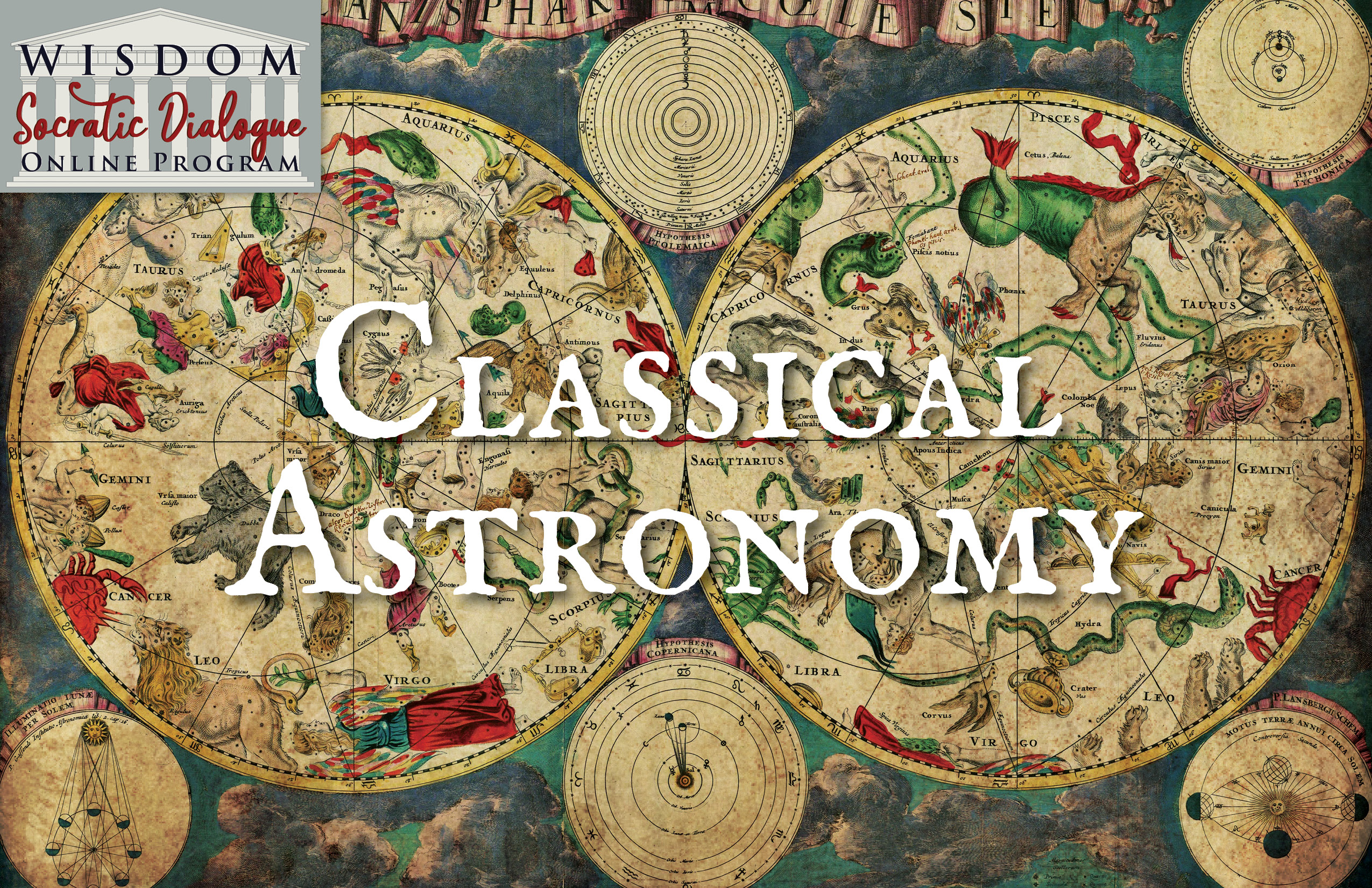
In this course, students will become acquainted with the basic phenomena of the sun, moon, planets, and stars. Students will see how Ptolemy (2nd cent. A.D.) took naked eye observations and came up with an earth-centered model that explained the motions of the heavenly bodies and allowed predictions of their future locations. After immersing themselves in this geocentric system, students will see why Copernicus's heliocentric model of the cosmos came to replace Ptolemy's, and how the heliocentric system was bolstered by the observations and theories of Kepler, Galileo, and Newton. This investigation of cosmic models will allow students to see the interplay of observation and mathematical theory that is found in many of the scientific disciplines.
Students will make observations of the sun, moon, planets, and stars, especially in the first portion of the semester. The main readings consist of excerpts from Ptolemy's Almagest, Copernicus's On the Revolutions of the Heavenly Spheres, Galileo's Starry Messenger, and Newton's Mathematical Principles of Natural Philosophy. Many of the readings are technical and will be accompanied by reading notes. In preparation for each class, students should expect to spend up to 60-90 minutes on reading and other assignments.
To Buy
- The Almagest: Introduction to the Mathematics of the Heavens by Ptolemy, Claudius. Santa Fe, Green Lion Press, 2021. (Copies can be found here and here. Please ensure that your purchase matches the above publisher information.)
Remaining readings and course material are provided to students in an online format below
Reading List:
Class 1 (Week 1): Observations and Basic Phenomena
- Complete the Observation Assignment
- Read Almagest, pp.1 - 8
Class 2 (Week 1): Introduction to Astronomy and Preliminary Mathematics
- Read Almagest, I.1-2, (pp. 23-27).
- Read Augros’ introduction to the sexagesimal system and then the section on the same topic in our Almagest book, pp. 9-11
- Notice that Augros and the editors of our book use two slightly different ways of denoting minutes and seconds of degrees. We will look at this handout on geometry in class or afterwards.
Class 3 (Week 2): Spherical Heavens and Earth
- Read Almagest Book I, Ch. 3-4 (pp. 27-30).
- Also, try to understand what each geometrical theorem on our handout from last class is saying. Try to solve any math problems that may have been assigned at the end of last class.
Class 4 (Week 2): The Ptolemaic Earth
- Read Almagest, Book I, Ch. 5-7 (pp. 30-34).
- Also, repeat observations of the night sky. Can you imagine the universe as a big sphere revolving around us? Does the sun set at a noticeably different place and time than it did about two weeks ago? Do you notice any difference in the location of the constellations compared to our earlier observations? How many of the constellations on your star chart can you find?
Class 5 (Week 3): The Two-Sphere Model
- Read Almagest, Book I, Ch. 8 (pp. 34-37).
- Read “Epitome of the Ptolemaic System” (Almagest, pp. 15-21).
Class 6 (Week 3): The Obliquity of the Ecliptic
- Read Almagest, Book I, Ch. 12 (pp. 56-59).
Class 7 (Week 4): The Astrolabe
- Read "Make Your Own Astrolabe" by Dominic Ford, sections 2-4.
- Then work through the excerpt from Evan’s The History and Practice of Ancient Astronomy, “Using the Astrolabe,” pp. 147-148. (Note that these problems are expressed for people using an astrolabe made for Seattle, Washington, but we’ll use astrolabes made for Edmonton and our answers would be different.)
Class 8 (Week 4): The Solar Year and the Sun’s Mean Motion
- Read Almagest, “Preliminaries to Book III” (pp. 77-80), and III.1 (pp. 81-90) and look at the tables in III.2.
(The section on Hipparchus’s troubles with getting things to work out perfectly is difficult, so on pp. 83-85 you can just try to get the main point and not worry about the details.) Try to follow what is going on in pp. 86-90, focusing on Calculations 3.9, 3.10-11, 3.14, and 3.15-19.
Class 9 (Week 5): Eccentrics and Epicyles
- Read Almagest, Book III , Ch. 3 up to Prop. 3.5 (pp. 94-97).
Remember to keep our sheet of geometrical propositions handy and to refer to it when the text includes a reference.
Class 10 (Week 5): Eccentrics and Epicycles continued
- Read Almagest, III.3.
- Work through Propositions 3.5, A.1, A.2, D1. Just note what the other propositions are showing, but don’t work through them step by step.
Class 11 (Week 6): The Solar Eccentricity and Apogee
- Read Almagest III.4 up to (but not including) Calculation 3.22 (pp. 104-8).
- Work through Calculation 3.20, 3.21.
- Also, reread “Dates of Equinoxes and Solstices” on p. 80 (note that the lengths of the seasons in 2010 are not the same as they were in Ptolemy’s time). The proofs will make use of several of our geometrical theorems on our list and we’ll also be using the Table of Arcs and Chords a lot. It will be helpful to draw a circle around right triangle EFN. He’ll also be doing quite a bit of arithmetic, often with sexagesimal numbers. Do your best and write down any questions about parts that you can’t figure out.
Class 12 (Week 6): Finding the True Sun
- Read Almagest III, Ch. 5 but when you get to the start of Calculation 3.26, skip to “Now, a complex table …” near bottom of p. 115 (so read pp. 109-111 and 115-6).
In class, we will work through the same methods but with a different example.
Class 13 (Week 7): Planets 1
- Print this document, which is a big table of planetary positions at 10-day intervals over a span of several years (taken from Evans, The History and Practice of Ancient Astronomy, pp. 290-4.)
- First see how the table is organized. At 10 day intervals, we get the position in the zodiac/ecliptic of the sun and the five visible planets. We measure in the ecliptic from Aries 0 as 0, so Taurus 15 would here be listed as 45 degrees. Attempt to complete the following exercises.
- Generally a planet’s position in the ecliptic goes up, but does it always go up the same amount in 10-day periods? Does it always go up?
- Looking at Venus’s motion over the course of a year, how far does it get from the sun? How long does it take Venus to return to the same position in the ecliptic?
- Looking at Mar’s motion over the course of two years, how far does it get from the sun? How long does it take Mars to return to the same position in the ecliptic?
- Use brackets to mark off all the intervals in which Mars is losing position in the ecliptic, i.e. when the number of its position is going down rather than up, which means that it is moving westward through the zodiac.
Class 14 (Week 7): Planets 2
- Read the first two sections of Almagest “Preliminaries to Book IX” (pp. 131-333),
- Read Almagest IX ch. 1-2 (pp. 141-5)
- Read the remainder of “Preliminaries to Book IX” (pp. 133-140). (Obviously, you do not have to read every entry in the table, but do refer to the tables and see if you can see in them what our helpful author is trying to show.)
Class 15 (Week 8): Planets 3
- Read Almagest IX ch. 3, 5, 6 (pp. 145-153, stop where it says “For let eccentric circle ABCD…”).
Class 16 (Week 8): Planets 4
- Read “Preliminaries to Book X” (pp. 155-56, since we will focus on Venus we do not need the rest)
- Read Almagest X.1 (pp. 161-162)
Class 17 (Week 9): Planets 5
-
Read Almagest X, Ch. 2-3 (pp. 162-6).
We will be working through proposition 10.2 and 10.3. Try to follow his main line of reasoning, but when he starts using demi-degrees (degrees where two right angles are made up of 360 degrees), try to use what we know about chords and arcs to get where he ends up getting to. For example, in Proposition 10.2, Ptolemy writes that angle AEF is 44;48 degrees. Noticing that triangle AFD has a right angle and putting a semicircle around it, how great would arc AF be, and thus how great is chord AF?
Class 18 (Week 9): Planets 6
- Read Almagest X, Ch. 6 (pp. 172-5).
Class 19 (Week 10): Summary of Ptolemaic System
- No assigned reading
Class 20 (Week 10): Copernicus 1
- Read Copernicus, De Revolutionibus, Preface, Book I, Ch. 5-6 (pp. 101-107).
Class 21 (Week 11): Copernicus 2
- Read Copernicus, De Revolutionibus, Book I, Ch. 7-9 (pp. 108-112).
Class 22 (Week 11): Copernicus 3
- Read Copernicus, De Revolutionibus, Book I, Ch. 10 (pp. 112-116).
Class 23 (Week 12): Tycho Brahe
- Read the Brahe section of this document (pp. 117-118). Can you imagine how the system of the universe is supposed to move? What are the strengths and weaknesses of this model of the cosmos?
Class 24 (Week 12): Galileo’s Astronomy
- Read the excerpts from Galileo, Sidereus Nuncius. Think about whether what Galileo sees proves that Ptolemy is right and that Copernicus was right.
Class 25 (Week 13): Kepler’s Laws
- Read the Kepler section of this document and the excerpts with his 3 Laws (pp. 118-120).
Class 26 (Week 13): Newton 1
- Read Newton, Principia, Definitions 1-5, Laws of Motion 1-3, and Phaenomenon 1 (pp. 194-6, 203, 244-5).
Try to understand the table in Phaenomenon 1. Notice that there are 4 columns for the 4 main moons of Jupiter. The bottom row is calculated from the observed periods of the moons using Kepler’s 3rd law. Can you replicate these calculations?
Class 27 (Week 14): Newton 2
- Newton, Principia, Phaenomenon II through the end of the Propositions (pp. 245-251).
Try to get an idea of what is being done in each Phaenomenon or Proposition. Focus on Proposition IV and its argument.
Class 28 (Week 14): The Pre-Modern Heavens
- Read “The Heavens” from C.S. Lewis’ The Discarded Image.

14 yrs and up, $175, 14 week course – Prerequisite: Foundational Great Books
In this course, students will learn and appreciate the ancient approach of the study of the natural world in the context of living things. This course will discuss the methods and fundamental questions of classic natural science. How do we come to know about the natural world? What are the principles of nature? What kind of knowing is instinct? What does it mean to be “alive”?
14 yrs and up, $185 - Prerequisite: Must have read The Hobbit and The Lord of the Rings Trilogy
Sojourn through the ages, reading works that influenced the great Tolkien including Greek and Norse mythology, as well as tales from England, Finland, and Germany. Each class will take time to discuss Tolkien’s works in light of these other stories poems, and sagas, and students can begin to glimpse the great wealth of inspiration that inspired the timeless characters of Tolkien's lore. While some readings may be challenging, they serve as a great reminder of the early legends and stories that continue to shape our culture and persistently fascinate the imagination.

13 yrs and up, $175 – No Prerequisite
By utilizing the Socratic Method of discussion, students will uncover timeless truths embedded in Nicholas Nickleby.Hot-tempered, daring, and wonderstruck Nicholas Nickleby breaks the law to save his friend Smike from his tyrannical, one-eyed master. Only nineteen years old, the two of them find themselves on the run, seeking their fortune wherever they can find it. Hilarity strikes as Nicholas finds himself in crazy situations only Dickens could dream up, but he must also use his wits and his fists against an array of villains who are determined to destroy him. Drama, humour, true love, tragedy, and surprises abound in a young Charles Dickens’ masterpiece.

12 yrs and up - $175.00 - 14 week course – No Prerequisite
Robert Schumann, pianist and composter, said, "To send light into the darkness of men's hearts - such is the duty of the artist." In this course, students will listen to the works of the masters, spanning the centuries, and discover the light that music sheds in the understanding of truth. Through the use of audio and visual activities and exercises, as well as reading, the students will experience the historical processes by which musical styles grow, develop, mature, and decline.
This course covers the music periods of Romantic (1860-1920) through to the modern era.
Intermediate Course (12 yrs and up), $185, 14 week course – No Prerequisite
It has been said by many that "Music is the universal language of mankind"; music tells a story through the use of sound to convey emotion and depict imagery throughout the ages. In this course, students will listen to the works of the masters, spanning the centuries, and discover the light that music sheds in the understanding of truth. They will engage in listening activities, readings, and class discussion to experience the historical processes by which musical styles grow, develop, mature, and decline. This process will help them to make connections between historical eras, art and music to understand the role music plays in the bigger picture of the elements that have shaped our cultures and societies.
This course covers the music periods of medieval music (1150-1400) through to the late Romantic era (1860-1920).
Senior Course (14 yrs and up), $335, 14 week course – Prerequisite: Intro to High School Writing or Mastering the Essay
This course is a sequel to the prerequisite courses. Like Intro to High School Writing and Mastering the Essay, it is a practical course designed to help the students improve their writing skills by expanding their writing experience through a diverse collection of styles. Students will delve deeper into specific writing genres, such as critique, allegory, persuasion, and tragedy, and continue to hone their writing abilities in preparation for any post-secondary choices. In this high school level writing course, the writing study will be enriched by pertinent selections for discussion from classic literature. This course includes a weekly private tutorial time in addition to the weekly assignment.
Extra private 30 minute tutorials are available upon request. (Cost: $25/tutorial)
Please contact Nicole Noster to receive more information or to book additional tutorials: nicole@wisdomhomeschooling.com
All lessons and readings are provided to students in an online format below.
Week 1: Descriptive Writing
Week 2: Critiquing, Evaluating, & Judging
Week 3: Metaphor & Simile
Week 4: Verse
Week 5: Allegory, Parable & Fable
Week 6: Logical Argument
Week 7: Persuasive Writing: Logos
Week 8: Persuasive Writing: Pathos
Week 9: Persuasive Writing: Ethos
Week 10: Dialogue
Week 11: Tragedy
Week 13: Film Script: Part I
Week 14: Film Script: Part II