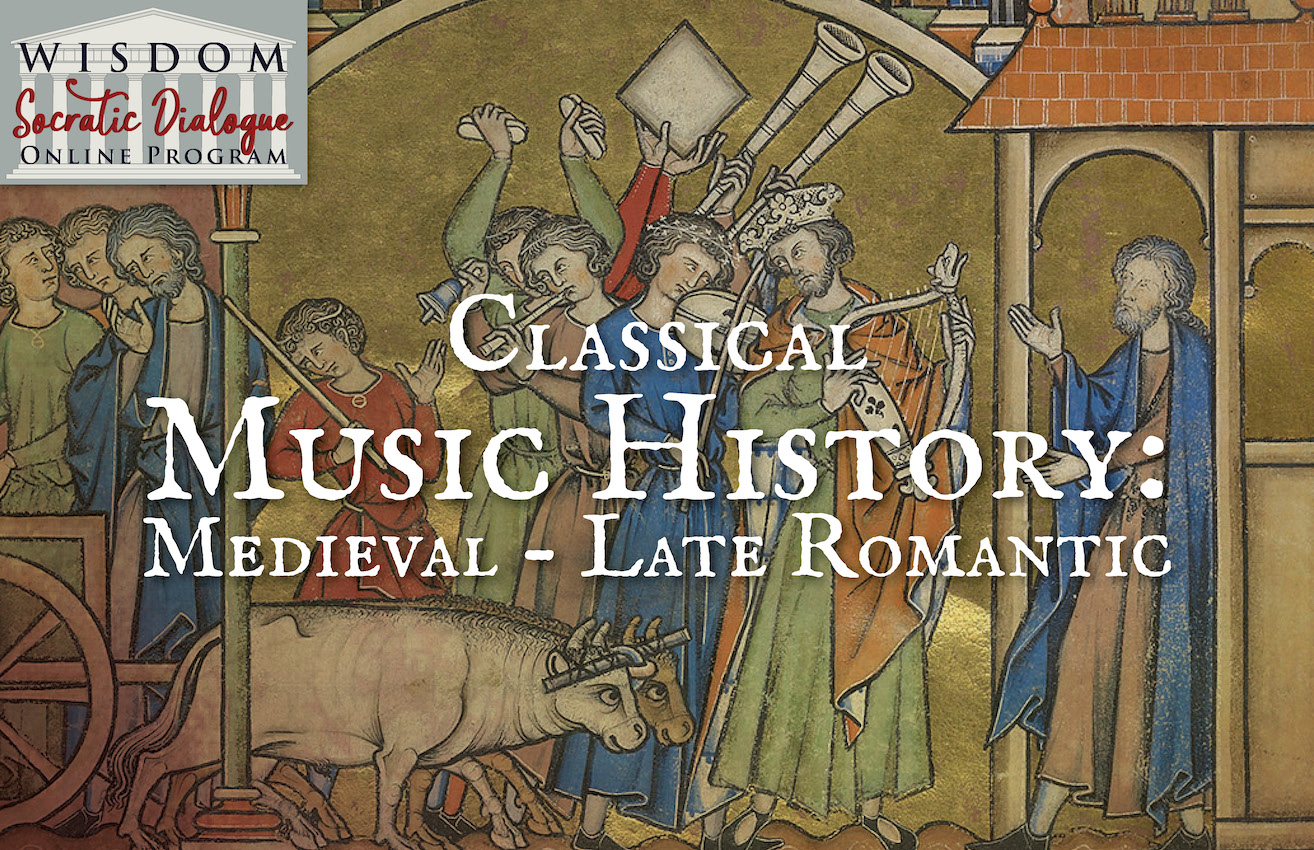
Intermediate Course (12 yrs and up), $195, 14 week course – No Prerequisite
It has been said by many that "Music is the universal language of mankind"; music tells a story through the use of sound to convey emotion and depict imagery throughout the ages. In this course, students will listen to the works of the masters, spanning the centuries, and discover the light that music sheds in the understanding of truth. They will engage in listening activities, readings, and class discussion to experience the historical processes by which musical styles grow, develop, mature, and decline. This process will help them to make connections between historical eras, art and music to understand the role music plays in the bigger picture of the elements that have shaped our cultures and societies.
This course covers the music periods of medieval music (1150-1400) through to the late Romantic era (1860-1920).
Parent/Child Course (10-12 yrs), $185 - No Prerequisite
The child and parent take this course together. This is a reading and discussion course. Animal themed literature is so fun and meaningful, and we can so often relate to the charming and poignant stories of our furry or feathered friends. A delightful reading list will engage the child with quality writing and will form an interesting foundation for taking discussion deeper than mere comprehension.
We recommend that parents review these books ahead of time to ensure they are a good fit for their children. Not all courses may be well-suited for each family, particularly when children are in a younger age range. We rely on parent discretion to determine whether or not a course will serve their child well.
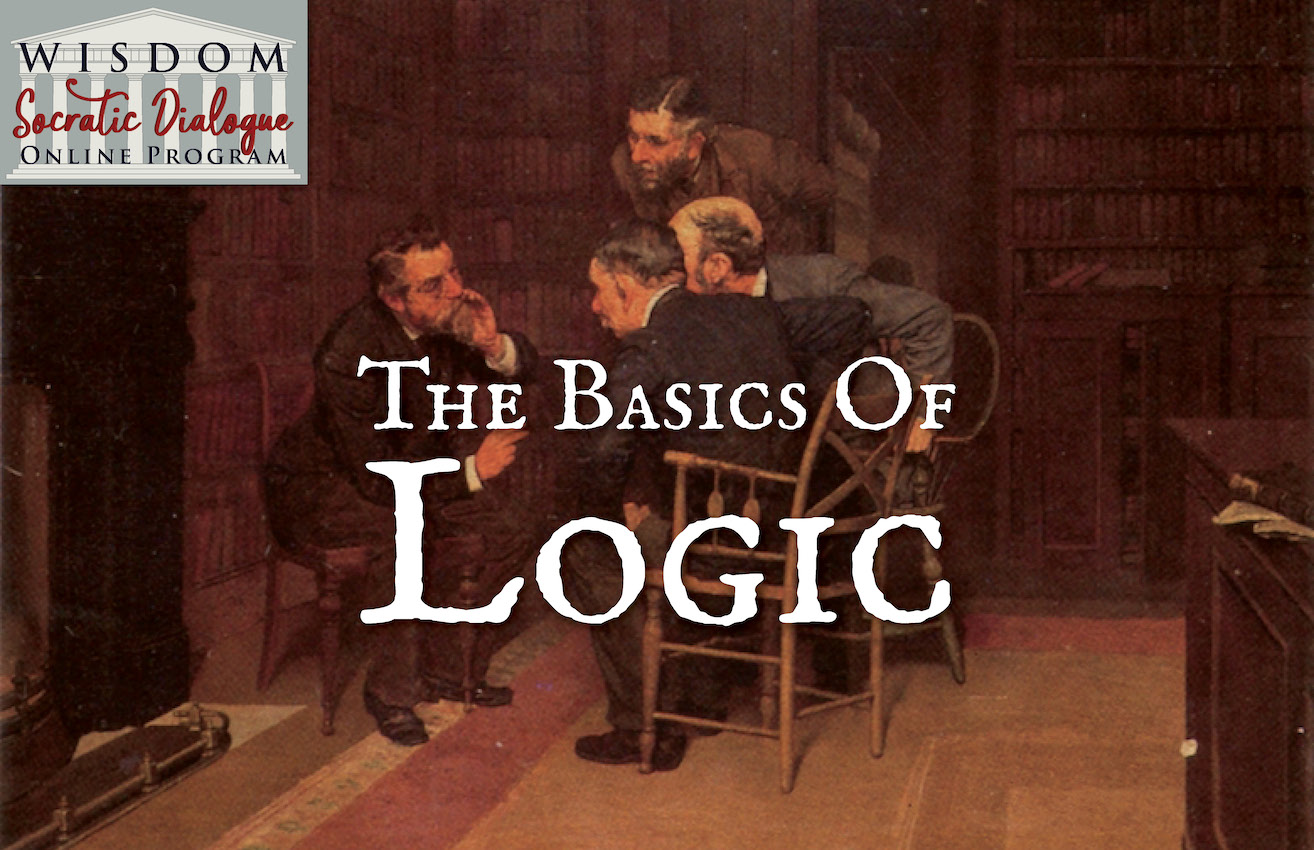
Intermediate Course (13 yrs and up), $195, 14 week course – No Prerequisite
Why did God give man a reasonable mind, the ancients asked, if not for the purpose of discovering the source of truth? Students will use discussion to stretch themselves in the art of clear thinking, grow in their ability to pursue the truth rationally, articulately, and persuasively, and recognize faulty thinking when they see it. In a world where communication grows ever more easy, this course will challenge students to know how to communicate well, discuss appropriately, and not shy from alternate opinions, but rather welcome them because they facilitate meaningful connections and open dialogue.
Intermediate Course (13 yrs and up), $195, 14 week course – No Prerequisite
This course is at the heart of WISDOM’s Socratic Dialogue Program and is a prerequisite to many senior level courses.
What makes a classic? Why read ancient books?
Our current culture has done a marvelous job to simplify life. Countless inventions are doing our work for us at the push of a button, freeing our time to focus on more important things. However, do we find that society at large uses this extra time for meaningful growth? Are popular pursuits typically edifying and challenging? Ironically, although we have ready access to incredible information, our culture is beginning to forget where it has come from.

13 yrs and up, $175 – No Prerequisite
By utilizing the Socratic Method of discussion, students will uncover timeless truths embedded in Nicholas Nickleby.Hot-tempered, daring, and wonderstruck Nicholas Nickleby breaks the law to save his friend Smike from his tyrannical, one-eyed master. Only nineteen years old, the two of them find themselves on the run, seeking their fortune wherever they can find it. Hilarity strikes as Nicholas finds himself in crazy situations only Dickens could dream up, but he must also use his wits and his fists against an array of villains who are determined to destroy him. Drama, humour, true love, tragedy, and surprises abound in a young Charles Dickens’ masterpiece.

University of Alberta, Augustana Campus
Augustana is a campus of the University of Alberta, located in Camrose, Alberta, Canada.
WISDOM Home Schooling is pleased to be partnering with Augustana Campus in a pilot project that invites WISDOM students to apply to Augustana with extremely homeschool friendly requirements.
For the first time, home education students will have a pathway to the University of Alberta that compliments the use of traditional homeschool resources, which are not Alberta curriculum specific.
Pursue Truth, Goodness, and Beauty through the WISDOM Socratic Dialogue Online Extra Evaluation courses, and enjoy a simple pathway to the University of Alberta, Augustana Campus.
Intermediate Course (13 yrs and up), $195, 14 week course – No Prerequisite
This course is a delightful introduction to the poetry of the English language with a focus on learning to understand and take pleasure in verse. While gaining the skills and nuance of reading poetry, students will concentrate on a different theme each week and study how various poets explore and challenge that theme through their poems. This is primarily a reading course, but students do have the voluntary opportunity to write and share their own verse in imitation of the week’s poems.
Senior Course (15 yrs and up), $195, 14 week course - Prerequisite: Foundational Great Books
Discover the world beyond political headlines and democratic institutions—the world that forged the path for the systems of government that dominate our international arena today. This course explores the primary thinkers in political philosophy, from Plato and Aristotle to Alexis De Tocqueville and John Locke. By digging into classic texts, we’ll consider the most fundamental questions about the very ideas that underpin the political sphere: What is justice? Is democracy the best form of government? What is just war? and What makes an ideal regime? Using socratic dialogue to engage with some of the greatest minds this world has ever seen, students will hone their critical thought, develop an arsenal of ideas for political critique, and come to understand politics as they have never understood it before.
13 yrs and up, $185 – No Prerequisite
Modern Classics serves as a great introduction for the Socratic Method style of learning. Students read classic literature of the 19th and 20th centuries with the goal of understanding predominant themes and analyzing the moral qualities of major characters. Over the course of the semester, students will develop their abilities to logically argue a position, cite examples from the text, and listen and respond to their fellow classmates.
Senior Course (14 yrs and up), $285, 14 week course/class twice weekly - Prerequisite: Foundational Great Books
In this course, students will become acquainted with the basic phenomena of the sun, moon, planets, and stars. Students will see how Ptolemy (2nd cent. A.D.) took naked eye observations and came up with an earth-centered model that explained the motions of the heavenly bodies and allowed predictions of their future locations. After immersing themselves in this geocentric system, students will see why Copernicus's heliocentric model of the cosmos came to replace Ptolemy's, and how the heliocentric system was bolstered by the observations and theories of Kepler, Galileo, and Newton. This investigation of cosmic models will allow students to see the interplay of observation and mathematical theory that is found in many of the scientific disciplines.
Students will make observations of the sun, moon, planets, and stars, especially in the first portion of the semester. The main readings consist of excerpts from Ptolemy's Almagest, Copernicus's On the Revolutions of the Heavenly Spheres, Galileo's Starry Messenger, and Newton's Mathematical Principles of Natural Philosophy. Many of the readings are technical and will be accompanied by reading notes. In preparation for each class, students should expect to spend up to 60-90 minutes on reading and other assignments.
To Buy
- The Almagest: Introduction to the Mathematics of the Heavens by Ptolemy, Claudius. Santa Fe, Green Lion Press, 2021. (Copies can be found here and here. Please ensure that your purchase matches the above publisher information.)
Remaining readings and course material are provided to students in an online format below
Reading List:
Class 1 (Week 1): Observations and Basic Phenomena
- Complete the Observation Assignment
- Read Almagest, pp.1 - 8
Class 2 (Week 1): Introduction to Astronomy and Preliminary Mathematics
- Read Almagest, I.1-2, (pp. 23-27).
- Read Augros’ introduction to the sexagesimal system and then the section on the same topic in our Almagest book, pp. 9-11
- Notice that Augros and the editors of our book use two slightly different ways of denoting minutes and seconds of degrees. We will look at this handout on geometry in class or afterwards.
Class 3 (Week 2): Spherical Heavens and Earth
- Read Almagest Book I, Ch. 3-4 (pp. 27-30).
- Also, try to understand what each geometrical theorem on our handout from last class is saying. Try to solve any math problems that may have been assigned at the end of last class.
Class 4 (Week 2): The Ptolemaic Earth
- Read Almagest, Book I, Ch. 5-7 (pp. 30-34).
- Also, repeat observations of the night sky. Can you imagine the universe as a big sphere revolving around us? Does the sun set at a noticeably different place and time than it did about two weeks ago? Do you notice any difference in the location of the constellations compared to our earlier observations? How many of the constellations on your star chart can you find?
Class 5 (Week 3): The Two-Sphere Model
- Read Almagest, Book I, Ch. 8 (pp. 34-37).
- Read “Epitome of the Ptolemaic System” (Almagest, pp. 15-21).
Class 6 (Week 3): The Obliquity of the Ecliptic
- Read Almagest, Book I, Ch. 12 (pp. 56-59).
Class 7 (Week 4): The Astrolabe
- Read "Make Your Own Astrolabe" by Dominic Ford, sections 2-4.
- Then work through the excerpt from Evan’s The History and Practice of Ancient Astronomy, “Using the Astrolabe,” pp. 147-148. (Note that these problems are expressed for people using an astrolabe made for Seattle, Washington, but we’ll use astrolabes made for Edmonton and our answers would be different.)
Class 8 (Week 4): The Solar Year and the Sun’s Mean Motion
- Read Almagest, “Preliminaries to Book III” (pp. 77-80), and III.1 (pp. 81-90) and look at the tables in III.2.
(The section on Hipparchus’s troubles with getting things to work out perfectly is difficult, so on pp. 83-85 you can just try to get the main point and not worry about the details.) Try to follow what is going on in pp. 86-90, focusing on Calculations 3.9, 3.10-11, 3.14, and 3.15-19.
Class 9 (Week 5): Eccentrics and Epicyles
- Read Almagest, Book III , Ch. 3 up to Prop. 3.5 (pp. 94-97).
Remember to keep our sheet of geometrical propositions handy and to refer to it when the text includes a reference.
Class 10 (Week 5): Eccentrics and Epicycles continued
- Read Almagest, III.3.
- Work through Propositions 3.5, A.1, A.2, D1. Just note what the other propositions are showing, but don’t work through them step by step.
Class 11 (Week 6): The Solar Eccentricity and Apogee
- Read Almagest III.4 up to (but not including) Calculation 3.22 (pp. 104-8).
- Work through Calculation 3.20, 3.21.
- Also, reread “Dates of Equinoxes and Solstices” on p. 80 (note that the lengths of the seasons in 2010 are not the same as they were in Ptolemy’s time). The proofs will make use of several of our geometrical theorems on our list and we’ll also be using the Table of Arcs and Chords a lot. It will be helpful to draw a circle around right triangle EFN. He’ll also be doing quite a bit of arithmetic, often with sexagesimal numbers. Do your best and write down any questions about parts that you can’t figure out.
Class 12 (Week 6): Finding the True Sun
- Read Almagest III, Ch. 5 but when you get to the start of Calculation 3.26, skip to “Now, a complex table …” near bottom of p. 115 (so read pp. 109-111 and 115-6).
In class, we will work through the same methods but with a different example.
Class 13 (Week 7): Planets 1
- Print this document, which is a big table of planetary positions at 10-day intervals over a span of several years (taken from Evans, The History and Practice of Ancient Astronomy, pp. 290-4.)
- First see how the table is organized. At 10 day intervals, we get the position in the zodiac/ecliptic of the sun and the five visible planets. We measure in the ecliptic from Aries 0 as 0, so Taurus 15 would here be listed as 45 degrees. Attempt to complete the following exercises.
- Generally a planet’s position in the ecliptic goes up, but does it always go up the same amount in 10-day periods? Does it always go up?
- Looking at Venus’s motion over the course of a year, how far does it get from the sun? How long does it take Venus to return to the same position in the ecliptic?
- Looking at Mar’s motion over the course of two years, how far does it get from the sun? How long does it take Mars to return to the same position in the ecliptic?
- Use brackets to mark off all the intervals in which Mars is losing position in the ecliptic, i.e. when the number of its position is going down rather than up, which means that it is moving westward through the zodiac.
Class 14 (Week 7): Planets 2
- Read the first two sections of Almagest “Preliminaries to Book IX” (pp. 131-333),
- Read Almagest IX ch. 1-2 (pp. 141-5)
- Read the remainder of “Preliminaries to Book IX” (pp. 133-140). (Obviously, you do not have to read every entry in the table, but do refer to the tables and see if you can see in them what our helpful author is trying to show.)
Class 15 (Week 8): Planets 3
- Read Almagest IX ch. 3, 5, 6 (pp. 145-153, stop where it says “For let eccentric circle ABCD…”).
Class 16 (Week 8): Planets 4
- Read “Preliminaries to Book X” (pp. 155-56, since we will focus on Venus we do not need the rest)
- Read Almagest X.1 (pp. 161-162)
Class 17 (Week 9): Planets 5
-
Read Almagest X, Ch. 2-3 (pp. 162-6).
We will be working through proposition 10.2 and 10.3. Try to follow his main line of reasoning, but when he starts using demi-degrees (degrees where two right angles are made up of 360 degrees), try to use what we know about chords and arcs to get where he ends up getting to. For example, in Proposition 10.2, Ptolemy writes that angle AEF is 44;48 degrees. Noticing that triangle AFD has a right angle and putting a semicircle around it, how great would arc AF be, and thus how great is chord AF?
Class 18 (Week 9): Planets 6
- Read Almagest X, Ch. 6 (pp. 172-5).
Class 19 (Week 10): Summary of Ptolemaic System
- No assigned reading
Class 20 (Week 10): Copernicus 1
- Read Copernicus, De Revolutionibus, Preface, Book I, Ch. 5-6 (pp. 101-107).
Class 21 (Week 11): Copernicus 2
- Read Copernicus, De Revolutionibus, Book I, Ch. 7-9 (pp. 108-112).
Class 22 (Week 11): Copernicus 3
- Read Copernicus, De Revolutionibus, Book I, Ch. 10 (pp. 112-116).
Class 23 (Week 12): Tycho Brahe
- Read the Brahe section of this document (pp. 117-118). Can you imagine how the system of the universe is supposed to move? What are the strengths and weaknesses of this model of the cosmos?
Class 24 (Week 12): Galileo’s Astronomy
- Read the excerpts from Galileo, Sidereus Nuncius. Think about whether what Galileo sees proves that Ptolemy is right and that Copernicus was right.
Class 25 (Week 13): Kepler’s Laws
- Read the Kepler section of this document and the excerpts with his 3 Laws (pp. 118-120).
Class 26 (Week 13): Newton 1
- Read Newton, Principia, Definitions 1-5, Laws of Motion 1-3, and Phaenomenon 1 (pp. 194-6, 203, 244-5).
Try to understand the table in Phaenomenon 1. Notice that there are 4 columns for the 4 main moons of Jupiter. The bottom row is calculated from the observed periods of the moons using Kepler’s 3rd law. Can you replicate these calculations?
Class 27 (Week 14): Newton 2
- Newton, Principia, Phaenomenon II through the end of the Propositions (pp. 245-251).
Try to get an idea of what is being done in each Phaenomenon or Proposition. Focus on Proposition IV and its argument.
Class 28 (Week 14): The Pre-Modern Heavens
- Read “The Heavens” from C.S. Lewis’ The Discarded Image.