Pages
WISDOM students enrolled in a senior high school program may choose to pursue Alberta Education courses for credits and marks in accordance with Section 6 of the Alberta Home Education Regulation. WISDOM respects parents as the primary educators of their children; when credits is the path families choose, WISDOM provides support and guidance to help students be as successful as possible in fulfilling Alberta Education’s requirements. WISDOM students gain credits primarily through a Course Challenge process, but also have the option to gain some credits through non-primary registration for Distance Education courses with another school.
There are pros and cons to pursuing Alberta courses for credits. Although it is not necessary for homeschooled students to follow the Alberta Programs of Study outcomes in order to graduate, WISDOM recognizes that some families choose to do so for reasons specific to their needs and goals.
Information about gaining credits with WISDOM, as well as the course challenge process can be found in the digital High School Credit Handbook below.
Course Challenge at a Glance
Course challenge is the means by which Alberta students who choose to not take school-delivered courses can obtain credits and marks. In brief, home educated students have the option to work through a program of study that matches the outcomes of Alberta courses, and upon formal evaluation of learning, an Alberta certificated teacher may award marks and credits.
- Parent & Student lets WISDOM know what courses the student will challenge and speak to the facilitator.
- Parent & Student develop a course of studies to meet Alberta Programs of Study outcomes for their courses.
- Parent & Student create course portfolios.
- Portfolios are submitted for evaluation (worth 70% in core courses or 100% in non core courses).
- Student takes final exams (worth 30% overall mark in core courses).
- Marks and Credits are awarded by WISDOM
So how do I put these Course Challenges in my EPP?
Links for high school credit support and information
- Time for a Real Education
Important article that provides answers to questions such as:
- “How will my child get into university or college?”
- “How will my child gain the credentials to earn a comfortable salary?”
- “How can I possibly teach high school?”
- Externally Delivered Credits
- Alternative High School Credentials
- WISDOM High School Credit Policy
- Proctoring Information
- Course Challenge Dates and Deadlines
- Alberta Programs of Study
- Alberta Diploma Exam Information
- Alberta Diploma Requirements
- Provincially Authorized Senior High School Courses
- Alberta myPass account setup
- Order a SOLARO account (Required to complete Course Challenge)
Want to speak with an experienced WISDOM staff member?
Christian Bekolay: High School Advisor
Peter Weidman: Credits Advisor
WISDOM High School Subject Specialists
High School Credit Handbook

What is a Portfolio?
A portfolio is a compilation of a student's academic achievements and experience. Portfolios are developed throughout a student’s entire education, but in a particular way during the high school years. For students in high school, WISDOM always recommends to start compiling portfolio material as early as possible. Some parents even like to include grade 9 in their student’s high school portfolios! Planning ahead and being organized will help to keep the portfolio development a smooth process.
High school portfolios often include a wide range of examples of student achievement and experience. These things could include:
- Dated samples of student work
- Records of student experience such as volunteer hours, work experience, or sporting events
- Copies of graded unit tests, assignments, quizzes, and practice exams
- Midterm exams
- Samples of essays and creative writing assignments
- Photos of projects
- Lists of literature studies
- Records of facilitator evaluations or tutor feedback
- And the list goes on...
Check here to see if there are upcoming portfolio workshops online or in person.
The article below provides an in depth explanation of the development, and philosophy of student portfolios.
Preparing A Portfolio – By Joyce Sehn
WHY a portfolio?
Portfolios continue to be a very effective method of communicating who you are, and what you can do. Presenting your portfolio in person, and talking about what it contains, adds reinforcement and credibility. This could greatly aid you in getting a job or a seat in the post-secondary institution of your choice. Your portfolio will distinguish you from the many others represented by a stack of applications. Years ago, if a young boy showed an interest in a particular field, he apprenticed with a master, practised until he had acquired great skill, and then produced his own masterpiece. Thus, the goldsmith’s beautiful piece of jewellery, the sculptor’s statue, and the tailor’s suit demonstrated competence in the chosen field.
Things are not very different in the professional world today. An architect shows a building he has designed, with plans and photos of his work. A furniture designer has photos and scale models of his designs. A violinist will perform, or submit a recording of a performance, and have a list of works studied, and so on. This is still the best way to show what you can do!
In an institutional setting, the focus is on curricula and outcomes, content and knowledge. Economic considerations dictate that simple methods be used for evaluating students, thus we have standardized tests, multiple choice questions, and letter or number grades. This method is useful in assessing how students compare to each other, but studies have shown it is not the best way to encourage or assess learning.
In a home setting, we have the freedom to focus on real learning and thinking skills, to develop a love for learning, and to become life- long learners. We can see firsthand what has been learned and the level of understanding achieved. This can be conveyed to others in a variety of ways, including the use of anecdotal notes, samples of work, and the student’s assessment of his or her own learning. This will show what makes them unique - precisely the purpose of a portfolio!
To develop a strong portfolio, it is helpful to answer the following questions:
1. WHO are you?
- What are your strengths and weaknesses?
- What are your likes and dislikes?
- What are your talents, interests and hobbies?
- What experiences do you have? What have you accomplished?
- What have you studied? What have you read?
- What are your distinguishing personality characteristics?
- Where have you lived? Where have you travelled?
2. WHEN and WHY are you preparing a portfolio?
Are you starting a portfolio for a six year old with the goal of preserving memories via photos and a scrapbook approach, or do you need a portfolio in the near future to present to an admissions officer of a college or university? Obviously, these two differing reasons will produce very different-looking results.
Everyone should start a portfolio as soon as possible! The habit of keeping records, saving samples, and filing things in a presentable manner is invaluable. Not only will you have a record for yourself, which you can enjoy reminiscing over in future years, but you will be ready to produce a portfolio to meet requirements when a need arises. It will evolve over time, changing and improving, depending on the need at the time, and the effort exerted.
Students need to be involved! It will be primarily Mom’s job in the early years, but just as older students must take responsibility for their education, they should take responsibility
for preparing their portfolio. This is important enough that it should be included in their program plan at the high school level. The process of preparing and presenting a portfolio, as far as the developing of skill is concerned, is almost as important as the end product.
3. WHAT should be included?
Once you have answered the above questions, you will be much better prepared to proceed. You must then choose what to include. Because no two individuals are the same, no two portfolios will be the same. The list of possibilities is virtually endless, but below are some ideas, in no particular order, from which you may choose (and add your own ideas):
- cover page with name, and a photo of yourself
- table of contents of your portfolio
- a description of your philosophy of education, your family’s vision/goals
- a list of strengths, weaknesses...all the things listed in “Who are you?” above
- lists of extra-curricular-type activities, community and church involvement
- a transcript of marks (given by parents or based on tests or outside evaluations)
- certificates from on-line courses
- diplomas, completion certificates, music festival awards
- lists of musical pieces studied, performances
- lists of concerts attended, places visited (such as museums, etc.)
- character reference letters, employer reference letters
- character development analysis checklist
- lists of courses studied, descriptions of courses
- educational goals, program plans
- log of readings
- photos, videos and audio tapes of activities, projects and accomplishments
- samples of photography, design, art work
- a resume (you may use the same one you would use to apply for a job)
- writing samples and work sheets, such as math tests
- tables of contents from curricula studied, test results
- lists of courses/workshops taken (swimming, first aid, baby-sitting, safety, computer)
- goals for future education and career plans
4. WHAT does a portfolio look like?
Generally, people use a binder or folder of some sort. If it needs to accommodate bigger things, such as original artwork for example, it could be quite large, but usually 8 1/2 by 11 size pages are sufficient. A three-ring binder simplifies arranging and rearranging pages to meet various needs. Non-glare plastic sleeves enable the insertion of pages without punching holes in original documents. A power point presentation could also be used, but the downside of this is availability of equipment. Decide on a simple method of compiling things. Just putting everything in a box may mean you’ll never get back to it, or that you’ll be overwhelmed with the task of organizing it when you eventually get to it, but it is a start. Slipping things into an album on a regular basis will keep things organized chronologically. Scanning documents, photos and projects is another option. When you need to present your portfolio, you can then choose and use relevant items.
A personal example:
Each of our youngest girls has two portfolios. The first is a photo-album type, which covers the early years of their home education. Pictures and certificates are quite prominent. Its main components include:
- photos of activities
- samples of penmanship
- art work (or photos of art work)
- reading lists
- lists of what was studied during this time (arranged by subject)
The second portfolio is a more serious-looking one, which covers the high school years. It includes:
- a description of a classical education and our philosophy of education
- lists of what was studied arranged by subject, including names of books and texts used
- samples of writing
- a list of books read
- descriptions of online courses and completion certificates
- a parent-generated transcript
- a WISDOM certificate recognizing High School Completion (which states that the student has completed the objectives set by the parents)
Much of the process of preparing these portfolios was enjoyable, but there were struggles, too. Deciding what to include, what format to use, and the order in which to present things, was not easy. But, the effort was well worth it! We have a great record of those precious years, and both girls gained admission to a university/college without any Alberta courses or credits, simply by presenting their portfolios.
Each home education student who successfully completes high school at home will have achieved the Alberta Home Education Regulation’s Schedule of Learning Outcomes at a high school level. This student is then qualified to receive a WISDOM Diploma or a WISDOM Certificate of High School Completion.
The completion of high school can include a variety of elements such as:
- A well-rounded education, tailored to the individual student, assisting them in finding and preparing for their calling and vocation(s)
- A classical approach
- Faith and character formation
- Mentorship and entrepreneurship
Benefits of a WISDOM Diploma or Certificate of High School Completion:
- Indicates completion of High School and readiness to enter the adult world
- Is an official document containing the WISDOM seal
- Accepted by some post-secondary institutions
- Accepted by many employers
Limitations:
- Insufficient evidence for some institutions
- Insufficient for some employers

Achieving the WISDOM Diploma
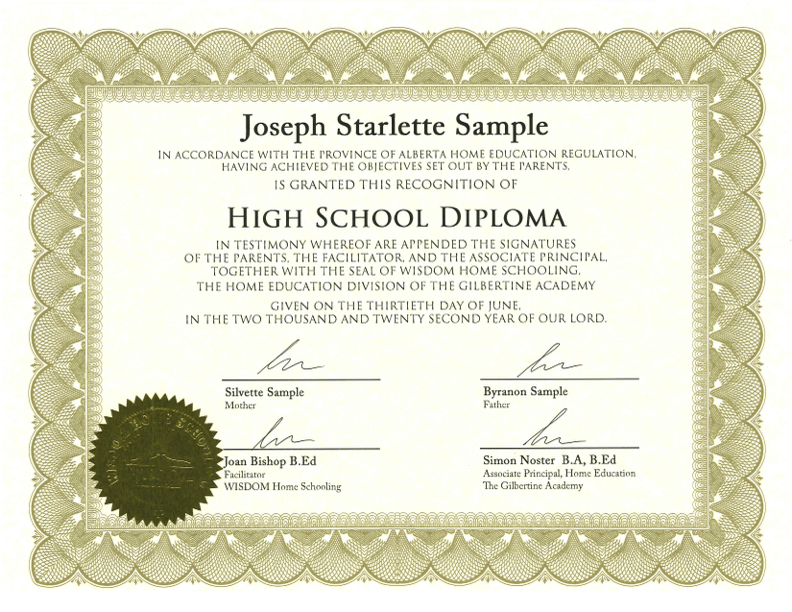 The WISDOM Diploma is an official document, verified by the facilitator and the associate principal of home education, complete with the WISDOM seal.
Please download the request form below. This form is to be completed by the student along with the parent(s). It is recommended to complete this form throughout the final year of high school rather than doing it all at once. Knowing the expectations of high school achievement in advance will help the student prepare to adequately fulfil all of the learning outcomes throughout high school.
Step by step process for achieving the WISDOM Diploma:
- Student and parent(s) develops portfolio throughout high school and has a completed portfolio available for the facilitator to review at the end of high school.
- Download the WISDOM Diploma Request form. In the form, the student enters a brief rationale of how each learning outcome has been met.
- When complete, the form is signed by the student and parent(s).
- Submit the completed request form to your facilitator for review.
- The facilitator reviews the form and may request a final portfolio review.
- Upon facilitator verification that learning outcomes were achieved, a WISDOM High School Diploma will be awarded and mailed to the student/parent(s).

Achieving the WISDOM Certificate of High School Completion
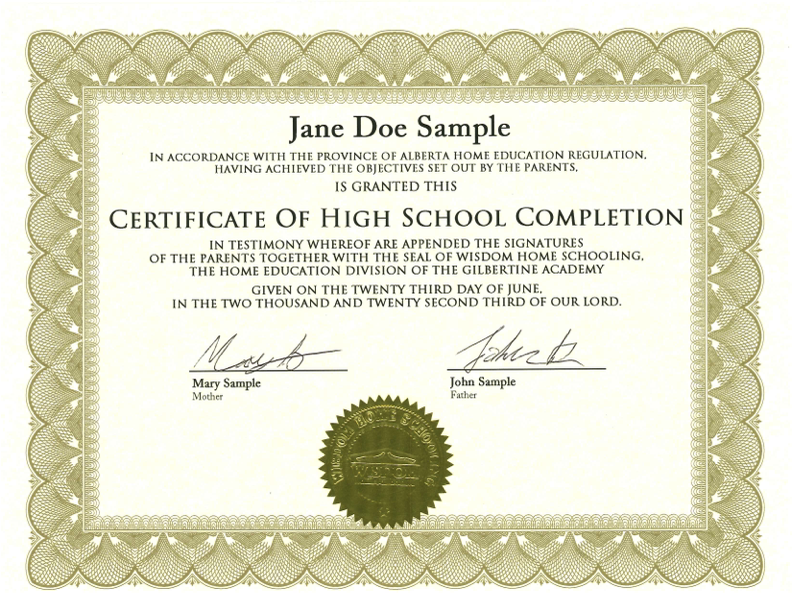 The WISDOM Certificate of High School Completion is an official document, verified by the parent(s), complete with the WISDOM seal.
Please download the request form below. This form is to be completed by the parent(s). Knowing the expectations of high school achievement in advance will help the student prepare to adequately fulfil all of the learning outcomes throughout high school.
Download Certificate Request Form
Step by step process for achieving the WISDOM Certificate of High School Completion:
- Student and parent(s) develops portfolio throughout high school
- Download the WISDOM Certificate of High School Completion Request Form.
- The parent(s) verify that each outcome has been met by checking them off on the form and signing it.
- Submit your completed form to highschool@wisdomhomeschooling.com.
- Upon receiving the request form, a WISDOM certificate of high school completion will be awarded and mailed to the student/parent(s).
Achieving the Alberta High School Diploma
As an alternative option to the WISDOM Diploma or Certificate of High School Completion, a student pursuing credits through the Alberta Programs of Study has the opportunity to achieve the Alberta High School Diploma. The Alberta Diploma is automatically awarded to a student who has successfully completed the required courses with 100 credits.
Benefits of an Alberta Diploma:
- Access to trade schools and college programs
- You may achieve the diploma while using supplemented home education curriculum
Limitations:
- May not allow direct access to University
- Time spent fulfilling requirements & writing provincial exams
For more information, please visit our information on Pursuing High School Credits.
- Alberta High School Graduation Diploma Requirements
- Home Education Regulation (See section 6 on high school credit eligibility for home education students)
myPass is an Alberta Education self-service website. With myPass, students can order high school transcripts, see Diploma exam results, register for Diploma exams, print a Detailed Academic Report (DAR), etc. Students pursuing Alberta high school courses, and post-secondary education in Alberta should create a myPass account.
myPass set up instructions
To set up myPass, You will need to register a student email address* with WISDOM by filling out the form below. Please allow up to three business days for WISDOM to update the student account. You will receive a confirmation email when this has been completed.
* The email address should be a current, personal student email address. School email addresses are not recommended.
Once the student email has been added to the education account, go to the Alberta MyPass welcome page for more information and signup instructions. You will need:
- Alberta Student Number (ASN) - found on your evaluation forms
- Student email account that is in the student record
- Student birth date
- Education Account - created as part of the process
Parent Access
Parents/Guardians can also be given access to student myPass accounts. WISDOM will enter Parent/Guardian email address to PASIprep, the Parent/Guardian then creates an education account with an email address that matches the email address registered by WISDOM in PASIprep. Finally, Parent/Guardian enters the correct Alberta Student Number and date of birth of the student in myPass. Please note: The parent/guardian connection automatically expires when the student turns 18 as they become independent students at this point.

What is a Parent Verified Transcript (PVT) of Courses and Marks?
A PVT is a summary record of marks or grades as verified by the parent (teacher) of a home educated student. It is an official document containing a table of individual courses or programs of study with corresponding marks or grades of the student’s high school year as verified by the parents.
WISDOM certifies this document by signing off on it, and providing the official seal of WISDOM Homeschooling.
A PVT may include grade 12 results alone, or any combination of high school grades.
Some institutions or businesses, especially in other provinces or the USA, may request grade 9 marks as well.
Samples of what a PVT might look like.
What is the PVT useful for?
A PVT provides parents and students with a personal record of high school achievement. It is an official, certified document that can be given to various post secondary institutions or businesses which require a transcript of marks for admission. It should be noted that some post secondary institutions require specific Alberta Course marks as found on an Alberta Transcript. The PVT may not satisfy these specific requirements. However, for cases that don't require specific Alberta Course marks, the PVT typically fulfills the requirements for admission. It is always advisable to speak directly to the institution or business the student wishes to apply to in order to determine if the PVT will be accepted for their particular admission requirements.
How do I get a PVT?
There are three methods of requesting a transcript:
- You can submit a transcript request through the website following this link: Transcript Form
- You can fill out a Transcript Submission form (available as fillable PDF and Word document) and email it to highschool@wisdomhomeschooling.com
- You can email highschool@wisdomhomeschooling.com the transcript information along with a list of courses studied, descriptions of the courses if desired, and final marks. Copy & paste the example below as a good email template:
Student Full Legal Name: Arthur Maximilian
Sample Date of Birth: July 07, 2004
Student ASN: 1165-2234-1 (if unknown the WISDOM office can provide this)
Parent Names: Jane & Brent Sample
Address: Box 123, Sample Road, Town, AB T0B 1C0
Phone Number: 1-780-123-4567
Graduation date to appear on transcript: June 23, 2023Grade 10
Mathematics: (Optional Description) 81% (or B)
English: (Optional Description) 94% (or A)
Home Economics: (Optional Description) 90% (or A-) et cetera.Grade 11
Mathematics: (Optional Description) 84% (or B)
English: (Optional Description) 98% (or A+)
Home Economics: (Optional Description) 89% (or B+) et cetera.Grade 12
Mathematics: (Optional Description) 80% (or B-)
English: (Optional Description) 90% (or A-)
Home Economics: (Optional Description) 98% (or A+) et cetera.
How do I determine a mark as a parent?
There are several methods of determining a mark, including:
- Portfolio of marked student work
- Facilitator feedback
- Parent observation
- Unit tests, practice tests, or final tests
- WISDOM online course feedback
- Teacher/Tutor feedback
- CTBS (Canadian Test of Basic Skills) testing results.
- CLT (Classic Learning Test)
It is important to understand that these marks are verified by the parent. There are many ways to evaluate student achievement that compliments their unique method of education. Parents have the capacity to determine the depth and breadth of their child’s learning.
It is essential that marks are based on authentic evaluation of completed objectives. Providing arbitrary marks can be damaging to a student's future.
What grading scale do I use?
As the parent teacher, you choose the method of grading. For example Alberta Education grades by percentage, the University of Alberta uses letter grades and grade point average, and any given school might have their own grading scale. Parents are free to choose to use percentage, a letter grade, both, or even your own terms such as “pass” or “complete.”
The following is an example of grading equivalency, which may be helpful in determining consistent marks for a transcript.
Letter grade: A+
%: 95–100%
GPA: 4.0
Letter grade: A
%: 90-94%
GPA: 3.9
Letter grade: A-
%: 83-89%
GPA: 3.7
Letter grade: B+
%: 77-82%
GPA: 3.3
Letter grade: B
%: 73-76%
GPA: 3.0
Letter grade: B-
%: 70-72%
GPA: 2.7
Letter grade: C+
%: 67-69%
GPA: 2.3
Letter grade: C
%: 63-66%
GPA: 2.0
Letter grade: C-
%: 60-62%
GPA: 1.7
Letter grade: D+
%: 55-59%
GPA: 1.3
Letter grade: D
%: 50-54%
GPA: 1.0
Letter grade: F
%: 0–49%
GPA: 0.0
How do I label the courses or programs of study on the PVT?
The parent decides how courses and programs of study to appear on the PVT. Here are three common approaches:
General PVT
Combine individual studies into one cumulative mark or grade for each subject. The rationale for this method is that post secondary institutions are often interested in simply one overall mark for each subject. This PVT of general courses is an easily recognizable format.
Detailed PVT
Some parents provide a very detailed PVT. This could include a long list of each individual subject, course, or program of study completed by their child with a corresponding mark or grade for each. This can be useful for your own personal records, and some institutions or businesses might be particularly interested in individual areas of student competency.
Focused PVT
Some parents like to have a specialized PVT targeted towards a specific post-secondary institution or business. This can be useful for students pursuing things such as a music degree, or seek to get into a particular trade.
The following is a general list of subjects/categories and various studies that generally fall under each. This list is not exhaustive, but may help parents plan the PVT.
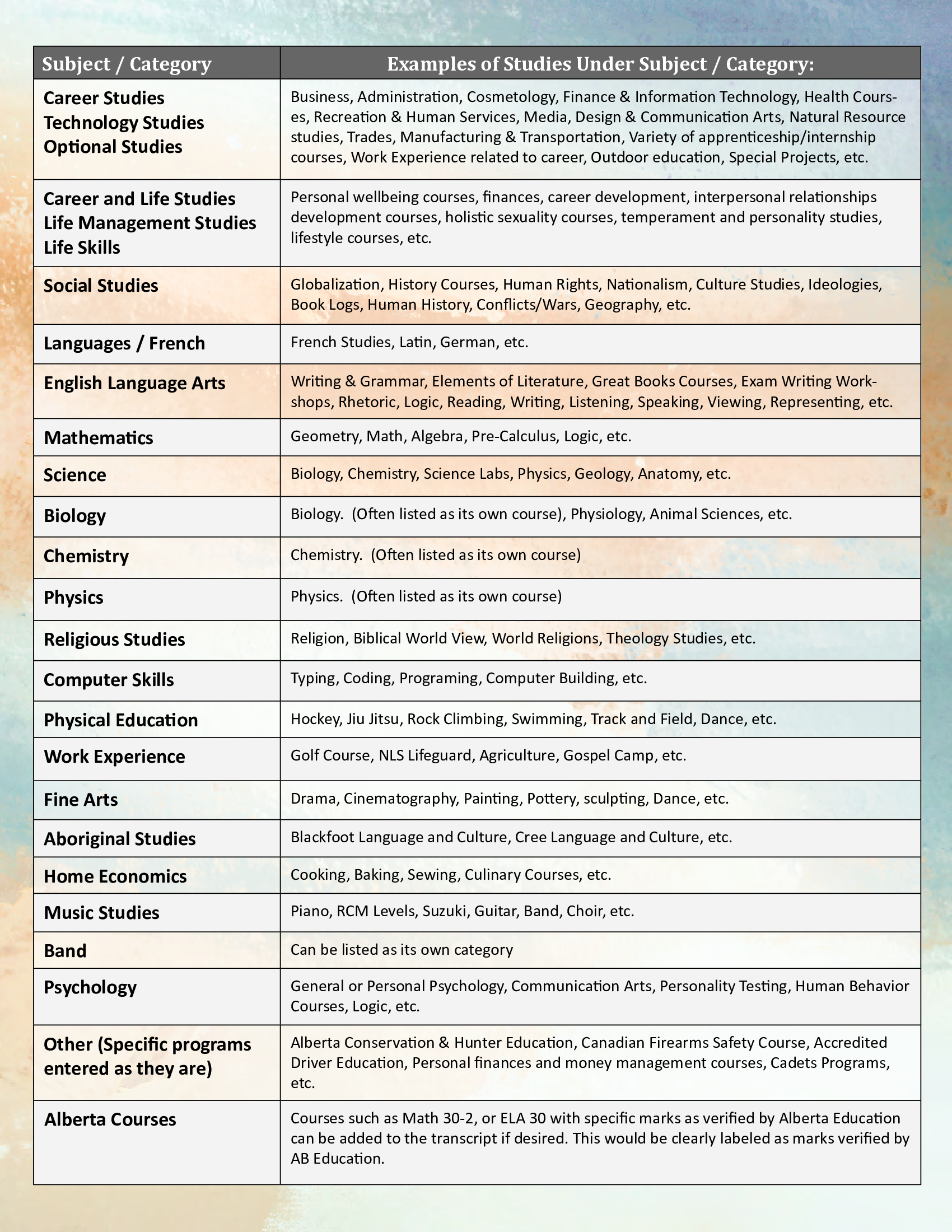
Can I request specific formatting and additions to the PVT?
Yes, there is great flexibility to the content and appearance of the PVT. WISDOM might offer suggestions to keep your PVT looking professional, but if there is a specific element you would like, please let us know and we will discuss options with you.
Please note, WISDOM Home Schooling certifies the document with the official WISDOM seal and reserves the right to refuse the addition of any element that would negatively reflect WISDOM as a whole.
Have Questions?
Any questions regarding the PVT can be directed to:
Christian Bekolay, High School Advisor
Email: christian@wisdomhomeschooling.com
Phone: 780-854-0489
Fax: 780-741-2113
WISDOM provides abundant options for home schooling throughout high school, right through to the work force or post-secondary education. Home schooling through high school is an excellent option, even for students who have taken online courses or previously attended a school. In this pursuit of a rich education experience, WISDOM is well known for offering full support to families as students complete high school at home through any one of a wide variety of paths. During visits with high school students, facilitators complete a High School Programs Choices form, which helps the family set concrete goals for high school at home.
Paths students can pursue could include:
- Entering the world of Work
- Apprenticeship
- Entrepreneurship
- Portfolio
- Alberta Education Transcript
- Alberta High School Diploma
- General Education Development
- Or other tests such as entrance exams, SAT’s, ACT’s, or CLT’s.
Whatever a student's path through high school to the world beyond, WISDOM supports parents in choosing the approach best suited to their unique child's gifts, goals, and calling.
Click the buttons below to go directly to your desired page, or scroll down to view or download the High School Information Handbook
- Transcript of High School Marks
- WISDOM Diplomas & Certificates
- WISDOM High School & Beyond Conference
- High School Events and Courses
- Creating a High School Portfolio
- High School Credential Options
- Pursuing Alberta High School Credits
- Univeristy Partnerships
Want to speak with an experienced WISDOM staff member? Find contact info for our high school advisor and subject specialists here.
Thank you for your submission!
To avoid delays, please review your submission below for errors and resubmit if needed. A copy of your submission has also been sent to the email address provided.
Your receipts have been received and are in queue to be processed for the next refund. Please allow up to 3 days after the deposit date for your bank to have processed the deposit and add the funds to your account. Details on the deposit schedule can be found here.
Receipt submissions submitted over the summer will be processed in October pending complete registration, approved EPP, and EFT application. See Funding Dates and Deadlines for more details.
Please note that all refunds are contingent on available funding. Our finance team will review your submission and will reach out should we require anything else.
Sarah is a registered Speech-Language Pathologist who has been the guest speaker for WISDOM’s Speech and Language Development Workshops.
Sarah is now offering to WISDOM families:
- Online Initial Speech-Language Assessments
- Online Follow-up Consult/Therapy Sessions
- Speech-Language Reports
For families in the Bonnyville-Cold Lake area in person services are a possibility.
Funding can be used for payment of services.
For more information, contact Thérèse at therese@wisdomhomeschooling.com, or call the WISDOM office.
New User
New users start here. If you are using a desktop/laptop, proceed to the tutorial for Returning Users, below.